
 Deutsch

3D Full-Body Photography – OptimaScan
Keeping an eye on your skin - today and over time.
Skin changes can evolve over time. Especially if you have numerous moles or an increased personal risk of skin cancer, it is therefore important to document these changes as reliably as possible so they can be compared during future examinations.
At our derma competence center in Zurich Enge, we combine many years of dermatological experience with modern digital imaging.
With 3D full-body photography, we can document your skin in a standardized and comprehensive manner. The images provide an additional basis for medical assessment and monitoring of changes during follow-up examinations.
A New Dimension in Skin Cancer Screening
The foundation of effective skin cancer screening is – and always will be – a personal examination by our dermatologists at our derma competence center.
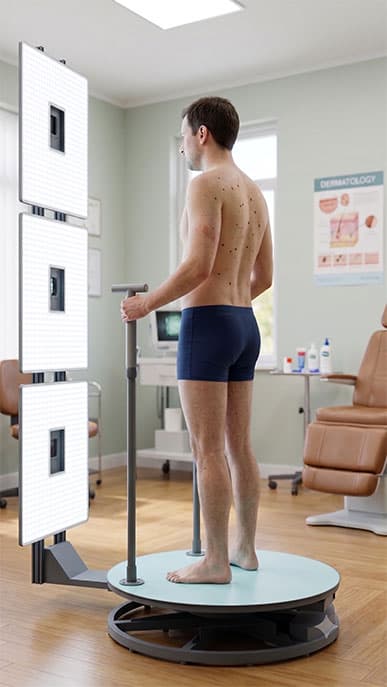
Modern 3D full-body photography adds a digital perspective to this examination: Instead of merely documenting individual suspicious skin lesions, the entire skin surface can be recorded in a standardized manner.
This creates a digital baseline that can be referenced again during subsequent checkups.
We don’t just view your skin as a snapshot – we can document its development!
AI-assisted technology can help systematically record skin changes and highlight new or altered lesions for further medical evaluation. The medical evaluation remains central to the process and is performed by a dermatologist.
Your Skin as a Digital 3D Map
3D full-body photography captures the skin from various angles and uses this data to create a three-dimensional representation of the body’s surface.
⇒ A complete view of the skin
Standardized full-body imaging allows for comprehensive documentation of the skin’s surface—even in areas of the body that are difficult to see during self-examination.
⇒ Standardized images for future comparisons
During a follow-up examination, the new images can be compared with previous documentation. This allows for a more targeted assessment of changes over time.
⇒ Structured documentation of skin changes
Relevant skin changes can be digitally recorded and localized. This provides an additional basis for monitoring progress.
⇒ An examination that grows with you
With regular checkups, a personalized record of your skin is created over time.
What are the benefits of 3D skin cancer screening?
⇒ Better Overview
The more moles and skin lesions there are, the more difficult it can be to reliably monitor changes over time. Full-body documentation provides a structured visual foundation.
⇒ Better Comparability
A single examination always reflects only a single point in time. Comparison with earlier images can provide additional information about the development of a skin lesion.
⇒ Targeted Monitoring
New or changing skin lesions can be specifically assessed during a medical examination and, if necessary, examined dermatoscopically.
⇒ Long-Term Documentation
Digital documentation makes it possible to track relevant findings across multiple examinations.
⇒ Technology as a complement – not a replacement
3D full-body photography does not replace either the medical examination or dermatoscopy. It complements traditional dermatological diagnostics with standardized digital documentation.
Who would benefit most from expanded skin cancer screening?
Particularly thorough and regular monitoring may be advisable for individuals with an increased risk of skin cancer.
⇒ In cases of numerous moles
Many pigmented skin lesions can make self-examination and follow-up monitoring difficult.
⇒ In cases of atypical or conspicuous moles
For moles that appear unusual, structured follow-up monitoring can provide additional information.
⇒ After a diagnosis of skin cancer
Following a diagnosis of melanoma or another type of skin cancer, regular dermatological checkups can be part of ongoing care.
⇒ In cases of a family history
A family history of skin cancer or melanoma can be taken into account when planning individual preventive care.
⇒ If you have an increased individual risk
Skin type, UV exposure, previous sunburns, and other factors can also play a role in assessing your personal risk.
⇒ If you’d like to document your skin over the long term
3D full-body photography may also be of interest to people who wish to systematically document their skin as part of regular dermatological checkups.
At the derma cometence center, we assess on an individual basis which form and frequency of skin cancer screening are appropriate for you.
Here's How Your Exam Will Proceed
1. Personal Consultation
We will discuss your personal medical history, skin changes, and relevant risk factors.
2. 3D Full-Body Imaging
Your skin is imaged from various angles using the 3D full-body photography system.
The imaging process itself is quick, contactless, and straightforward.
3. Dermatological Examination
Digital imaging is combined with a personal dermatological examination.
4. Targeted Examination of Notable Skin Changes
Notable lesions or those requiring monitoring can be further examined using a dermatoscope.
5. Digital Documentation
Relevant skin changes are documented in a structured manner and can be referenced for follow-up examinations.
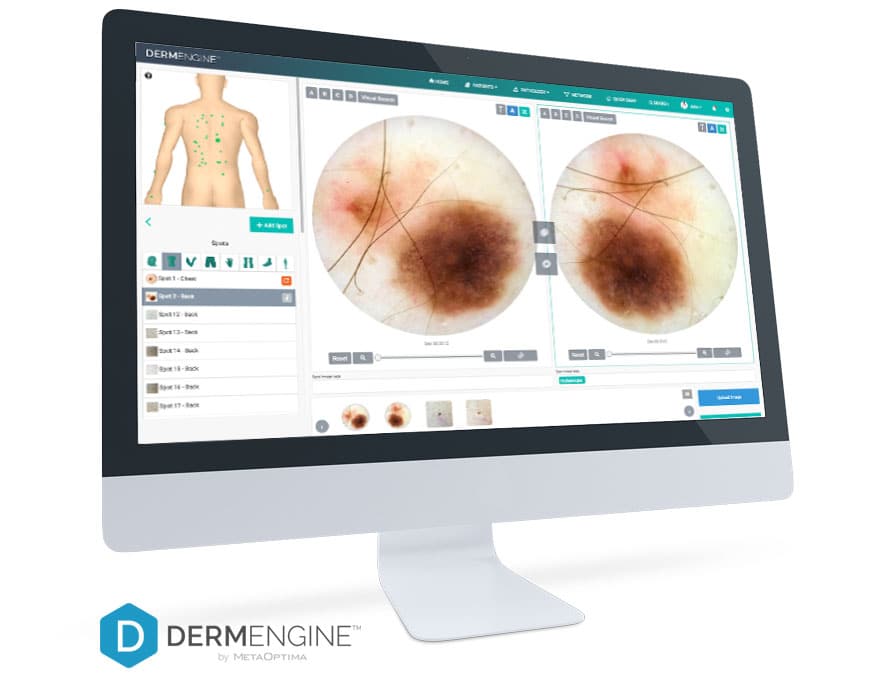
DermEngine supports structured analysis and subsequent comparison. The AI features serve as an additional layer of support and assurance alongside the medical examination.
6. AI-Assisted Evaluation
DermEngine supports structured analysis and subsequent comparison. The AI features serve as an additional support and layer of assurance alongside the medical examination.
7. Medical Evaluation and Consultation
The results are medically evaluated and discussed with you in detail. This medical service, covered by health insurance, is an essential part of
OptimaScan – Advanced 3D Imaging for Skin Cancer Screening
For 3D full-body photography, we use OptimaScan in combination with DermEngine.
The system was developed for standardized full-body photography in dermatology. The skin is captured from various angles and digitally documented as a three-dimensional image.
⇒ 360° Full-Body Scan
The skin is captured from various angles and comprehensively documented.
⇒ High-Resolution Imaging
The digital scan provides a detailed representation of the skin’s surface.
⇒ 3D visualization
The images are used to create a three-dimensional representation of the body.
⇒ Digital Follow-up Monitoring
Previous examinations can be used for comparison during subsequent checkups.
⇒ Quick and Easy
The actual full-body scan is performed quickly and is non-contact.
Technology Meets Dermatological Expertise
Even the most advanced technology is only as valuable as the medical expertise used to interpret its data.
3D full-body photography provides structured digital documentation. The medical evaluation is performed by a dermatologist – taking into account your individual medical history, your risk profile, and the clinical appearance of your skin.
If necessary, we supplement the examination with dermatoscopy or other diagnostic procedures.
Digital imaging provides additional information. The medical evaluation remains our responsibility as physicians.
What is the difference between this and a standard skin checkup?
The classic dermatological examination remains the foundation of all skin cancer screening.
3D full-body photography supplements this with standardized digital documentation.
| Standard Skin Examination | Advanced Skin Cancer Screening |
|---|---|
| Medical Examination | Medical Examination |
| Assessment of skin changes | Assessment of skin changes |
| Dermatoscopy as needed | Dermatoscopy as needed |
| Documentation of relevant findings | Additional standardized full-body documentation |
| Assessment at the time of the examination | Additional option for comparing progress over time |
Not one or the other – but both: dermatological expertise combined with modern digital documentation.
Your Benefits at a Glance
Holistic: The skin is documented as the entire body surface.
Comparable: Standardized images provide a basis for future follow-up.
Digital: Relevant skin changes can be documented in a structured manner.
Personalized: The medical assessment is performed by your dermatologist.
Modern: We combine dermatological expertise with modern 3D imaging.
Long-term: With regular checkups, you can build a continuous digital record of your skin.
Why choose us at dcc for skin cancer screening?
Experience and Specialization
Assessing skin changes requires experience, medical expertise, and a trained eye.
Modern Diagnostics
We combine established dermatological examination methods with modern digital imaging capabilities.
Personalized Care
For us, the focus isn’t on technology, but on your unique skin and your personalized preventive care.
Ongoing Support
When regular checkups are recommended, previous examinations and digital records can be taken into account during subsequent appointments.
A special advantage of the derma competence center:
We offer everything under one roof – from skin cancer screening and digital progress monitoring to medical evaluation and necessary treatment, such as excision, through to follow-up care and any required additional checkups.
Based on current knowledge, the derma competence center is thus among the early adopters of this technology in Switzerland and Europe.
Frequently Asked Questions About 3D Skin Cancer Screening
What is 3D full-body photography?
In 3D full-body photography, the skin is photographed from various angles using a standardized method and combined into a three-dimensional image.
How does 3D skin cancer screening work?
The full-body examination is combined with a personal dermatological examination. Any notable skin changes can also be examined using a dermatoscope if necessary.
What role does AI play in the investigation?
The AI features of OptimaScan and DermEngine can assist with the systematic documentation, analysis, and comparison of skin lesions. They serve as an additional safety measure alongside a dermatologist’s examination, but do not replace a medical examination or medical evaluation.
How long does the full-body scan take?
The actual registration process takes only a short time. The duration of the entire appointment depends on the scope of the medical examination and the individual findings.
Is the exam painful?
No. The full-body scan is non-contact and painless.
Does a 3D scan replace a visit to a dermatologist?
No. 3D full-body photography complements the medical examination. The medical evaluation is still performed by the dermatologist.
Can OptimaScan detect skin cancer?
OptimaScan supports standardized full-body photography and digital documentation. The dermatologist determines whether a skin lesion requires medical evaluation. If necessary, additional diagnostic procedures, such as dermatoscopy, are used.
Who would benefit from 3D full-body photography?
It may be of particular interest if you have numerous moles, atypical nevi, a personal or family history of skin cancer, or an increased individual risk of skin cancer. We will determine on a case-by-case basis whether it is appropriate for you.
How often should the examination be performed?
This depends on your personal risk of skin cancer, any changes in your skin, and the results of previous examinations. The screening interval is determined on an individual basis.
What happens if a suspicious mole is discovered?
Any noticeable skin changes are evaluated by a doctor and, if necessary, examined using a dermatoscope. Depending on the findings, follow-up monitoring, further diagnostic tests, or treatment may be recommended.
Can I have just a few moles checked?
Yes. The full-body scan is intended for systematic documentation. Individual suspicious skin lesions can also be specifically evaluated as part of a medical examination.
How are my recordings protected?
The images will be processed as part of your medical records and are subject to the applicable requirements for the protection of personal and medical data.
How much does 3D skin cancer screening cost?
The costs depend on the scope of the examination and the services required on an individual basis. We would be happy to provide you with personalized information about the current costs.
The 3D full-body scan, as well as the digital or AI-assisted image analysis, are additional services that must be paid for privately and are not covered by mandatory health insurance. However, the subsequent medical evaluation and discussion of the scan play an essential role: This is a medical service covered by insurance and is billed separately according to the applicable rates and depending on the individual’s insurance coverage. The medical assessment determines whether further testing or treatment is necessary.
Your skin deserves a holistic approach.
Modern skin cancer screening. Personalized. Precisely documented. State-of-the-art.
Schedule an appointment for your personalized skin cancer screening with 3D full-body photography.